My Journey to Parish Ministry:
The Path That Led Me Back to Church
The foundation of my religious life was established when I was a child. Quite simply, I was raised in a family that affirmed the importance of good behavior, faith, and loyalty. I was shaped by my parents, and the generation of grandparents and great-aunts and uncles that surrounded me, to uphold traditional conservative Yankee values. Given this backdrop of close extended family, my involvement with church, and the florescent picture of Jesus that glowed in my room when the lights dimmed, I can say with both conviction and a smile that my religious superego was under construction pretty early.
It was only in my early thirties that my career path honed in on Parish Ministry. Prior to finding Unitarian Universalism, it was not clear exactly where my call to be of service, make a difference, save the world, (choose your favorite clichéd phrase) would lead me. It was only when I had fully tested my interest in being a professional activist and human service provider at a management level could I really discern that Parish Ministry would be my primary career. I have been at a new level of peace since I made that decision.
What was always clear since childhood was that I would find a vocation centered in some version of service. This commitment to being of use was established when I was a child. I was raised in a family that affirmed the importance of good behavior, faith, and loyalty. My parents and the generation of grandparents and great-aunts and uncles that dominated our neighborhood bathed me in a silent culture of traditional, conservative Yankee values. Given this immersion in a conservative extended family, my regular attendance at church, and a florescent picture of Jesus that glowed in my room when the lights dimmed, I can say with both conviction and a smile that my religious super-ego was under construction pretty early.
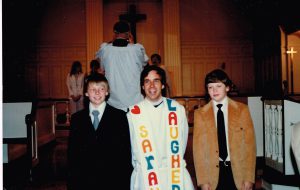
When I was in junior high and high school, I served as a church acolyte at the local Episcopal Church. At one point I was the youngest person in the Episcopal Diocese of Massachusetts qualified to act as a diaconate minister. Giving out communion as an early teen feels, in hindsight, informative and important. Playing that role was something of a small honor for my family, and shaped my own identity. In those teen years being the grandson of an Episcopal church pillar and working with the local church pastor, I got a backstage view of church life. From the time I was capable, I began to ask deep religious questions. Theology is my first intellectual love. It felt good. Soon enough, I was humorously – but not insignificantly – dubbed “The Reverend” by some in my family.
I entered my teen years with the sense that my childhood was normal. I had a healthy enough dose of the popularity, self-esteem, and athletic skill that makes one’s teen years more fun than traumatizing. I am grateful for that. Not everybody gets that. I was the sensitive football player who knows that everybody deserves that! Still am.
In the scope of my family’s history, my two younger brothers and I were supposed to be the generation of this working class family that did not work with our hands. However, perhaps even a bit ironically, academics were not a significant priority in my home. I did ok in school, but I don’t believe I read more than a handful of books before graduating from High School. I will never forget being in high school and riding in my Dad’s truck down Storrow Drive in Cambridge, MA. Amidst the hammers and tape measures bouncing about, my very smart but simply educated Dad asked me if I was going to apply to Harvard. It was a humorous and disjointing moment. Harvard?
It was in college where I first connected the religious and moral principles of my upbringing with the world of progressive political ideas. That combination is a lot of who I am. As an undergrad, although I still identified myself as a Christian, the firmness of that identity was shifting under my feet. I remained committed to the principles of my youth, but like many college students do, I went on a journey of exploration and skepticism. The more I learned, the more skeptical and yet curious I became.
Although in college I was formally a Corporate Communications major, the best of my intellectual energies was spent absorbing the political visions extended down from voices like MLK, Ralph Nader, and Dorothy Day. I remember being propped up in the corner of two cinderblock dorm walls, filling my head and heart with the first notions of my call of the intentional religious and political life.
Those first few years of college, away from home, were important years for me. By my junior year, I had become the Founder or President of three student groups, and was a leader in the school’s small protestant community. I had a few early leadership experiences as a kid, being the oldest of two brothers, playing quarterback year after year, and being a leader at church, but to me my college years were the first of many important forays into growing into who I am. I would call the very serious manner and direction in which I first spread my wings at college an important turning point. My roots were growing some wings.
If my undergraduate years ignited my interest in the way politics and religion come together, it was in graduate school at Boston University that I honed my capacity for critical thinking. Concentrating my ministerial studies in Social Ethics, I sobered, deepened, and clarified those inclinations and ideas that had just years before worked to make me who I am.
It was not until graduate school that my father’s innocent question about Harvard, would ever have been conceivable. Had I not received a full scholarship from Boston University School of Theology, I might have fought to defect “across the river.” It didn’t, doesn’t and wouldn’t have mattered. BU couldn’t help the fact that I was sliding away from the Christian tradition and, too, a blurrier but more honest moral and spiritual place. Although the United Methodist Church contributes directly to each BU Divinity student, it was ironically the broadening of my religious life at BU that made me a UU. Sorry, John Wesley.
Between 1990 and 2000, roughly the decade of my twenties, I was in, returning to, or somehow always nearly finished with my “MDiv” degree. During my decade-long graduate school career, I was a social justice activist, a human service worker, a traveler, a family caregiver, and of course at all times “a student.” It was a slow journey, with lots of twists, memories, and life lessons. Hell, it was my twenties and I was not married, and hadn’t figured out exactly what I was going to do. I mostly regret the mild anxiety that comes with exploring.
I entered Parish Ministry at about the same time I was experienced enough to hold leadership roles in the human services, be a political activist, and explore being a non-profit manager. In hindsight, I would have probably taken out a few loans, both worked and lived a bit less, finished BU earlier and ideally clarified sooner that my gifts were best expressed in the parish, and not as a professional activist. However, that is a wish too weak to call regret.
As I said early on, as much as I was committed to a life of service, by my mid-twenties I felt religiously in-between. Like so many of us in the modern world, I was unable to discount the love, depth, and sense of wonder that I grew up with that always drew me to religion, but I was equally unable to ignore all the information that made me a late twentieth-century skeptic. It was right then that I found Unitarian Universalism, and in pretty quick succession my career path. I did not set foot into a UU church until I was 27 years old, but once I did, I felt like I found my religious home. Pretty quickly thereafter I turned my vocational attention towards being ordained as a Unitarian Universalist minister. I did not know for the first few years of this pursuit whether that ministry would be in a community or a parish setting, but I was honing in on a calling/career.
My call to parish ministry over community ministry was never driven so much by the belief that the role of activist, social reformer, or even human service provider is any less important than being a church minister. I am called to parish ministry quite simply because my gifts are there. I am a more naturally and better a parish minister than any of the many other helping or transforming professional roles I have considered. In short, my capacities shaped my “call.”
At the turn of the century, having finished all but a few extended projects required to complete my Masters in Divinity at BU, I moved to Chicago to intern as a Community Minister for The National Interfaith Committee for Worker Justice. However, working at NICWJ and being affiliated with Third Unitarian Church, I shifted to parish ministry. Respectively 2000 to 2002 were the time I formally made the switch from envisioning myself a Pastor who did Community Organizing to a Pastor centered in the Church, and committed to making our communities agencies of change.
Had I grown up UU, and not first set foot in a UU church in my mid-twenties, I don’t think I would have resisted the call to Parish Ministry for so long. I am a natural. Centered in a community, albeit a community with a mission to not only be together, but change the world, is where I belong; and what I will do for the rest of my professional life.
Having made that decision, completed my internship, and unceremoniously graduated, I returned home to Lexington and received Preliminary Fellowship. In the Fall of 2003, I began serving as the quarter-time Minister of the Northfield MA UU church. Smoothly, and without fanfare, my prelude to ministry ended, and my ministry as a professional had begun.
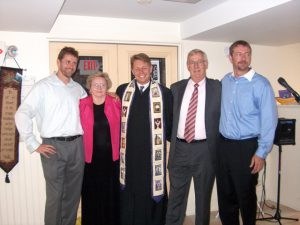
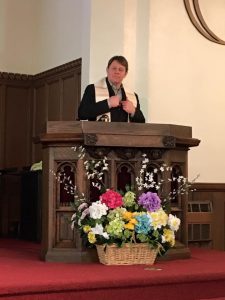
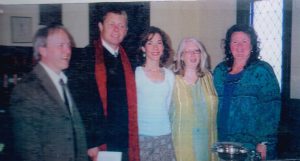
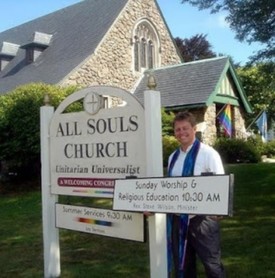
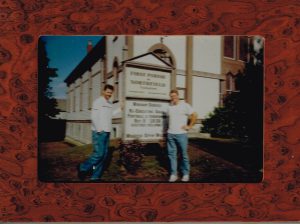
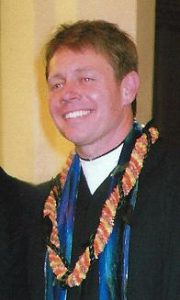
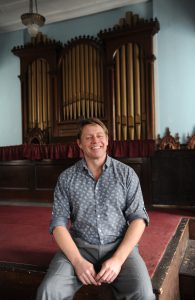
Dates of Distinction on my Journey to Ministry
U.U. Fellowship (date): 2003
Ordination (ordaining body, place, date): 2007
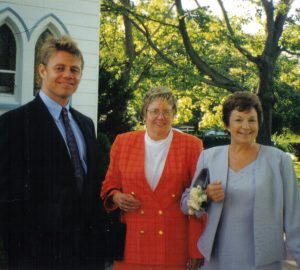
On September 9th 2007, I was ordained jointly by The Unitarian Universalist Church of Rutland VT, the Bernardston Congregational Unitarian Society, and The First Parish of Northfield, MA. (The three churches I was serving at the time.) The ordination took place in The Rutland VT UU church
Education and Certifications: I graduated from Lexington High School in 1985, and enrolled the following fall at Ithaca College. In 1989 I graduated from Ithaca with a Bachelor of Science in Corporate Communications and with minors in Psychology and Religion. In the following spring, (1990) I began a Masters in Divinity Degree at Boston University as an Oxnam Scholar (a full academic scholarship granted for a student’s mix of academic achievement and community service.) I spent the next thirteen years in and out of my “MDiv” program working, traveling, and aiding an aging extended family. In 2013 I graduated from BU with a specialization in Social Ethics and Social Policy.
I did my career assessment in 1997 at Newton’s Center for Career Development and Ministry and interned as a Community Minister with the National Interfaith Committee for Worker Justice in Chicago from 2000 to 2001. In the following year, (2001-2002) I interned at Third Unitarian Church as a Pastoral Minister. Likewise, I have done two units of Clinical Pastoral Education. The first in the summer of 1996 at Saints Memorial Medical Center in Lowell and the next in the summer of 2002 at McNeal Hospital in the Chicago Suburbs.